Speed-to-Lead in 2026: The Revenue Leak You Can Fix This Week
If you run a home service business, you don’t usually have a “lead problem.”
You have a speed problem.
Homeowners don’t submit one request and wait patiently. They typically contact multiple providers, and the fastest responder wins.
And the data is blunt: responding quickly is one of the most reliable ways to increase bookings—without increasing ad spend.
Why speed-to-lead matters (the stats)
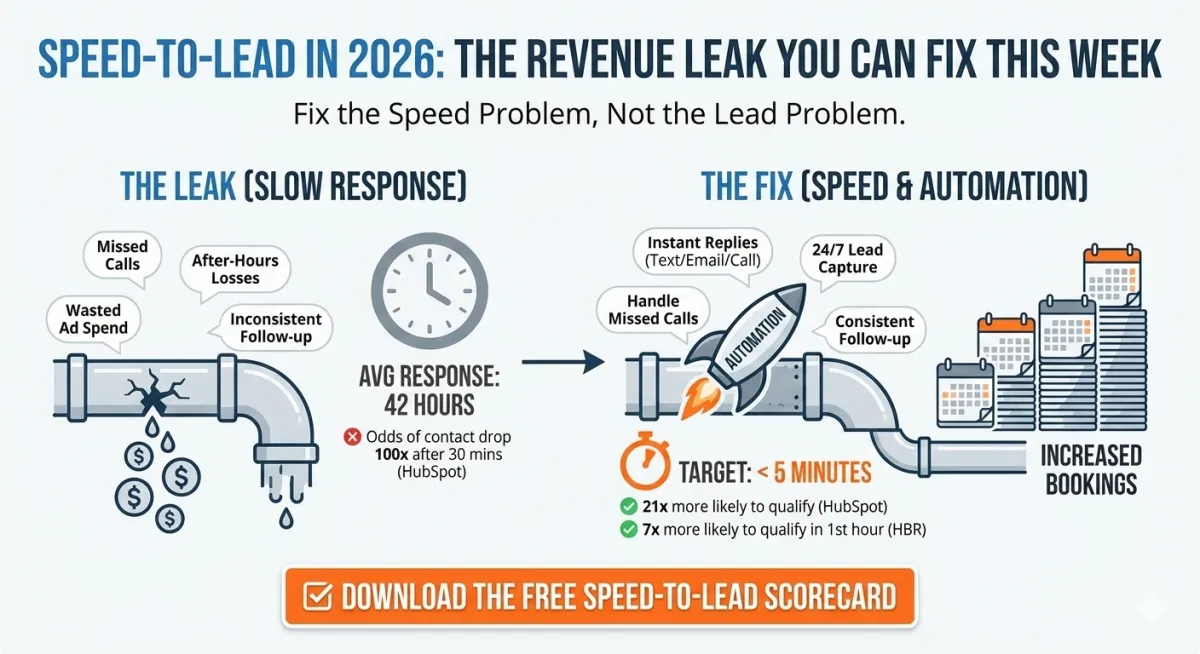
5 minutes vs. 30 minutes: The odds of contacting a lead drop by 100x when you wait 30 minutes instead of responding within 5 minutes. HubSpot
Qualification lift: Leads contacted within 5 minutes are about 21x more likely to become qualified than leads contacted after 30 minutes. HubSpot
The first hour is critical: Companies that try to contact a lead within an hour are nearly 7x more likely to qualify that lead than those who wait even one more hour. Harvard Business Review
Most businesses are slow: In the same Harvard Business Review research, the average response time among companies that responded was 42 hours, and 23% never responded at all. Harvard Business Review
The real-world pain points of slow follow-up
When response time slips, the losses are predictable:
Missed calls during the day (because you’re on a job, driving, or short-staffed)
After-hours leads that go to voicemail and never get handled fast enough
Wasted marketing dollars because you paid for the call… then lost the race
Inconsistent follow-up when things get busy (and leads fall through the cracks)
It’s not just theory—missed calls are common. One call-tracking provider reports that 28% of calls to businesses go unanswered on average. callrail.com
And customers still want the phone channel: TransUnion research found nearly 80% of consumers consider phone important for communicating with businesses. TransUnion Newsroom
What “good” speed-to-lead looks like
A strong speed-to-lead system doesn’t rely on someone being available 24/7. It ensures:
New calls are answered live whenever possible
Web forms get a confirmation quickly (and aren’t checked “whenever we remember”)
After-hours leads are captured and handled first thing next day
Leads get 2–3 follow-up touches, with templates, and someone “owns” the process
Why automation is the simplest way to win
You can do this manually—but the scorecard says it best: you’re already busy doing the work.
That’s where BookFast AI Respond, created by 97Leads comes in. It’s built to help you respond fast and consistently by:
instantly replying to new leads via text/email and/or phone calls
handling missed calls when you’re in the field
keeping the conversation going until the job is booked (or forwarded to staff)
Bottom line: Speed-to-lead becomes a system, not a guessing game.
Download the Speed-to-Lead Scorecard (Free)
If you want to know exactly where your follow-up is leaking jobs, start here:
✅ Download the Speed-to-Lead Scorecard — a quick checklist to reveal how fast you really respond, where leads slip through the cracks, and what to fix next.

